Simplicty

14 May

“I do believe in simplicity. It is astonishing as well as sad, how many trivial affairs even the wisest thinks he must attend to in a day; how singular an affair he thinks he must omit. When the mathematician would solve a difficult problem, he first frees the equation of all incumbrances, and reduces it to its simplest terms. So simplify the problem of life, distinguish the necessary and the real. Probe the earth to see where your main roots run.”

– Henry D. Thoreau to H.G.O. Blake, 27 March 1848

Falling in Love

20 Apr

The following is an excerpt from Byron Katie’s book “I Need Your Love – Is That True?” (pages 61-65).

—-

Falling in Love

The search for approval from friends, associates, and family members is a full-time job with no vacations. At its center lies the search for ultimate approval, the search that all the songs are about, for the person who will look at us and say, “You’re the one.” We call this “falling in love.” In this chapter we’ll look at falling in love and becoming a couple, and we’ll see who is really “the one.” 
     Falling in love is usually understood completely backward, like so many other important things. There’s no mystery to falling in love. We have fallen out of the awareness of love and are ecstatic when we find our way back, misunderstanding how we did it. Remember the little girl doing flips in the corner of the playground? She has the key. Look at her face, lit up with the excitement of perfection. She’s overjoyed just to be there with her legs and arms to play with. There is absolutely nothing more that she wants or needs, and she’s too absorbed in the moment to realize it. The flip she does is an expression of love itself. When she does the flip again, looking to see if she can win applause, she shifts her focus outward and cuts herself off from love. But love doesn’t go anywhere; she just loses her awareness of it. Later in life, people call experiences like this “falling out of love” and think that they’re about the other person.
     The little girl is innocently misdirected. She begins to think that the way back to her happiness—to a perfect moment—depends on the reaction of the other kids. Even though the awareness of love is always available, years might pass before she has it again, years she devotes to searching for love and approval outside herself. 
     When you’re constantly trying to be likeable, you leave no gaps in your life in which you can just breathe and notice what you already have, no chance to experience the unlimited options that those gaps are filled with. Even after you’ve attracted admirers and supporters, you’re still busy seeking results. You have to make sure that your friends do all the things friends are supposed to do—invite you to parties, send work your way, console you when you feel depressed. And it‘s never enough. You’re constantly on the lookout for any evidence that you’re not approved of or adored. 
     “Falling in love” is a powerful experience. If you look back, you may remember it as a moment when you stopped seeking. You stopped because you thought you’d found what you were looking for. Your mind was no longer filled with the effort, the desperation, of seeking. What you found is what you had in the corner of the playground and never really lost. But now you think it’s coming from another person, someone who is “the one.” 
     Many people fall in love for the first time as teenagers. By that time the simple playground joy has vanished (actually you left it, but that’s not how it seems). Dark thoughts appear—anxiety about how you’re not all right and how no one can ever love you. Then the miracle happens: Suddenly there is someone to love, and you can stop searching. Maybe it’s a boy in your chemistry class or a singer you saw at a rock concert. Maybe it’s a movie star or your best friend’s new girlfriend. With this kind of love you’re just as happy when there’s no hope of return. You don’t mind if a kiss is completely out of the question because you have braces on your teeth, or because you would never betray your friend, or because there is no possibility of meeting the rock star. These may be the very reasons that you let yourself love completely. 
     When you look back on that first crush, it’s possible to see that the girl you adored had nothing to do with it. Years later you can run into her again, stare at her all you want, and not have a clue what you saw there. You would have done anything to marry her, and now you’re grateful that she never noticed you.
     If the love isn’t coming from the other person, then who does that leave for the love to come from? There’s only one person left: you. You gave yourself the experience. The blissful feeling was not caused by how wonderful or sexy your best friend’s girlfriend was. It was you who felt the wonder and the excitement. Someone held up a mirror and showed you your heart. 
     There are those who say that a crush is a delusion, that it wasn’t real because it all came from you. Another way to look at it is that the crush was as real as any experience you’ll ever have: you just made a mistake about where the joy was coming from. The source wasn’t the brown-eyed girl or Leonardo DiCaprio; it was your own long-lost capacity to experience pure joy. When you had the crush, you found your way back to the child doing flips, just for herself. That’s the one you abandoned in order to seek an identity that you thought others would recognize. What we may think of as “first love” really takes us back to love itself, which is what we are to begin with.
     You find other ways to fall in love when you get older. As you leave your teens, the worst of your awkwardness diminishes; your approval-getting skills get better with practice. After many trials, you may find someone who approves of you so much that they tell you, “You’re the one.” You like that. You like to be approved of that much. And maybe you approve of them for other reasons as well (and maybe not, and even that won’t necessarily stop you).
     Since you’ve been approved of, you can ease up for a while: there’s much less straining to please and charm. Without your efforts getting in the way, love just flows. You bask in the happiness of it. Sometimes it seems like there’s enough love to include everyone and everything you meet. Again, you’ll probably think it’s all about him, the one who thinks you’re the one. But the happiness is really you returning to yourself. Love was there all along; only your painful thoughts obscured it.
     How long does that joy last? Grownup love is like the crush—it lasts only until painful thoughts cover it over. “What if she doesn’t really love me?” “He doesn’t listen.” “She shouldn’t have flirted with that guy.” Any one of these thoughts will destroy your happiness. And one way or another, that happiness will have to vanish as long as you believe the thought that love—the joy you stumbled into—depends on the other person.
     Most people believe that having love in their lives and escaping loneliness depends on finding some special person. This is an ancient belief, and it takes courage to question it. But if you do, you’re in for a big surprise: You can feel love either with or without someone in your arms. And no, that doesn’t mean that you won’t have a partner. Why would it? When with and without are equal, you notice that both are good: life allows all flavours, and all of them turn out to be your favourite.
     The old song asks, “Why do fools fall in love?” Actually, only fools don’t fall in love. Only a fool would believe the lonely, stressful thoughts that tell him that anything could separate him from another human being, or from the rest of the human race, or from birds, trees, pavement, and sky.

Seven Tools for Personal Transformation

5 Apr

Evolution of a young plant

This is my shortlist of tools for personal transformation.

1.) Seek Truth
If we are interested in personal growth, then we must cultivate a love of truth, which means observing ourselves and learning that there is a difference between what we think and what we are (“the map is not the territory”). When we seek truth we stand outside of ourselves and evaluate our feelings, our relationships, and our assumptions. As we seek truth, we look for that small light peering through a crack in our stories and we scratch at it. As we learn to accept what is real in the present moment, we are more able to accept whatever arises in us, because we know that it is not the whole of us. While our automatic reactions can derail our search for the truth, acknowledging their presence brings us closer to the truth. When we are willing to be with the whole truth—whatever it is—we have more inner resources available to deal with whatever we are facing.

2.) “Not Doing”
The process of spiritual growth sometimes seems paradoxical because we speak of struggle and effort as well as of allowing, accepting, and letting go. The resolution of these apparent opposites lies in the concept of “not doing” or what I’ve previously called “radical acceptance.” Once we understand “not doing,” we see that the real struggle is to relax into greater awareness so that we can see the manifestations of our own shadows. By neither acting on our automatic impulses nor by suppressing them, we begin to understand what is causing them to arise. Not acting on our impulses creates openings through which we can catch glimpses of what we are really up to. Those glimpses often become some of our most important personal transformation lessons. At first, we may need to intentionally set aside time to practice “not doing,” but over time we may find this practice more fully integrating into our day-to-day way of being (as a friend of mine once said, “the point of basketball is not the timeouts”).

3.) Cultivate a Community
The more support we have for our personal development, the easier our process will be. If we are living or working in a dysfunctional environment (family, community, work, etc.), personal growth is not impossible, but it is more difficult. Most of us cannot leave our jobs or our families so easily, even if we are having difficulties with them, although we can seek out others who give us encouragement and act as witnesses to our growth. Beyond this, we can find groups, attend workshops, and put ourselves in situations that foster the other six tools listed here. Getting support also entails structuring our days in ways that leave room for the people that nurture us. It’s likely that you already have some people like this in your life, but if not then you can easily seek them out. Just remember that support comes to those who offer support (universal law of karma), so you’ll have to risk being vulnerable.

4.) Learn from Everything
Once we have involved ourselves in the process of personal growth, we understand that whatever is occurring in the present moment is what we need to deal with right now. And whatever is arising in our hearts or minds is the raw material that we can use for our growth. It’s common to flee from what we are actually facing into our imagination, romanticizing or dramatizing our situation, justifying ourselves, or escaping into distraction. Staying with our real experience of ourselves and our situation will teach us exactly what we need to know for growth. As we seek truth, we must also be willing to learn from it and develop a “learning orientation,” which means that we look for opportunities to  grow rather than opportunities to accomplish. When we learn from everything we’re free to take chances and make mistakes.

5.) Find Self Love
It has been said many times that we cannot love others if we do not love ourselves. But what does this mean? We usually think that it has something to do with having self-esteem. Perhaps, but one central aspect of a mature love of ourselves is caring about our growth sufficiently not to flee from the discomfort or pain of our actual condition. We must love ourselves enough not to abandon ourselves—and we abandon ourselves to the degree that we are not fully present to our own lives. When we are caught up in worry, fantasy, tension and anxiety, we become dissociated from our bodies and our feelings—and ultimately, from our true nature. True self love also entails a profound acceptance of ourselves—returning to being present and settling into ourselves as we actually are without attempting to change our experience. It is also aided by seeking the company of people who possess some degree of this quality themselves.

6.) Use Your Body
When we think about personal transformation is it easy to intellectualize it and get wrapped up in the changes that happen emotionally, but we must not forget that physical changes often accompany any changes that happen inside. Some people may start with physical work (exercise, diet, yoga) and find that other areas of their life get better, while others may find that as they do interior work, they are starting to feel better physically. The point is that our interiors (thoughts, emotions, beliefs, attitudes) and exteriors (neurons, brainwaves, cells, body) are linked to each other, so if we’re going to endeavor towards personal transformation then we must account for and activity engage the physical body.

7.) Have a Practice
Most transformational teachings stress the importance of some kind of intentional practice, be it spiritual (meditation, prayer, relaxation), physical (weight-lifting, running, yoga), or intellectual (reading, writing, Sudoku) or some combination of them. The important thing is to set aside some time each day to reestablish the scaffolding that you need to support your growth. Practice interferes with our deeply ingrained habits and gives us opportunities to wake up from our trance. Eventually, we understand that every time we engage in our practice we learn something new, and every time we neglect our practice we miss an opportunity to allow our lives to be transformed.

One major obstacles to personal transformation is the expectation that we attain results. The ego seizes on breakthroughs and wants to recreate them on demand, which often only furthers the illusion that we can control everything. The reality is that we are always growing and changing whether we want to or not. The key choice we have to make is whether we want to grow elegantly and intentionally or just get dragged along for the ride.

The Key to Happiness -Build a Boat

1 Apr

If you observe a truly happy man, you will find him building a boat, writing a symphony, educating his child, growing double dahlias or looking for dinosaur eggs in the Gobi Desert. He will not be searching for happiness as if it were a collar button that had rolled under the radiator, striving for it as a goal in itself. He will have become aware that he is happy in the course of living life twenty-four crowded hours each day.

– W. Beran Wolfe 

10 Awful Leadership Models

25 Mar

I love crappy ideas and apparently other people do to. Leadership in particular is an area that seems to get a lot of attention. Maybe these hucksters think they can make a quick buck by selling a few books. Maybe they just think so little of leadership that they’re willing to brand it on anything. Whatever the reason, I find this leadership models disturbing and hilarious. Here are my top ten.
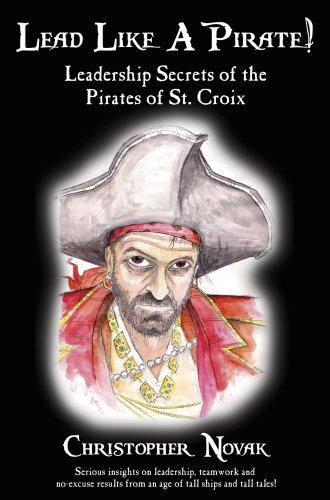
The author is given credit for admitting that the approach is “light-hearted” and for putting a graphic description right up front. As Novak explains, there are five elements to the model; the captain, the crew, the mission, the strategy, and the treasure. What I love most is that the entire book is filled with mysterious numbered lists. Lists like, “the four characteristics of an effective captain,” or, “the three principles of pirate strategy.” None of which seem to be connected to any larger conceptual framework (other than numerology). The whole thing reads like a series of leadership platitudes interspersed with lines from Pirates of the Caribbean. Favorite quote: “Do you know what is more powerful than cannon, cutlass, or pistol? Reputation. Aye, reputation.” (page 34). Read this if your ideal manager wears an eye patch and expects you to sit on his shoulder and repeat everything he says.
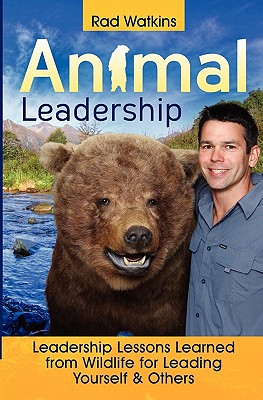
Part self-help fluff and part personality theory, Watkins capitalizes on our obsession with seeing human qualities in animals (and vice versa). His four “power animals” the bear, the wolf, the eagle, and the horse, comprehensively catalog and summarize the wide diversity of human traits, personality, behaviors, beliefs, skills, perspectives, contexts, and motivations. I won’t get into some of the more technical problems with these descriptions since it clearly isn’t meant to be taken too seriously. Favorite line: “The bear does not have the capabilities that allow it to communicate clearly. It is making decisions on the fly as to whether or not it needs to leave a situation, threaten severe consequences, or actually bring down the hammer. In the bear’s defense, even when they do maul people they rarely kill.” (page 13-14). There is little value here especially if one has successfully graduated from the 7th grade (or equivalent). Read this if you want to make the author’s grandmother feel like his career decisions weren’t “a delusional mistake.”
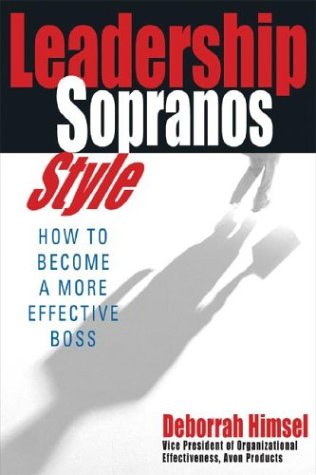
Jessamyn West once said, “fiction reveals truth that reality obscures,” and it when it comes to leadership theory it seems that some people would prefer to study imaginary people rather than real leaders. As with all of these models, there is some wisdom – some old wine in new HBO-branded wine skins, but the question then comes to mind: what was wrong with the old wine skins? Is the study of interpersonal and group dynamics just too boring? More than anything, this book is clearly an interpretive exercise for the author rather than a guide for questions about leadership. Favorite line: “I’m sure I would react skeptically if I heard about a book called Bart Simpson on Leadership or The Leadership Secrets of Ally McBeal.” (page xxvii). *please note the irony. Read this is you want something to plagiarize for your high school essay that you can be sure no one else will have read.
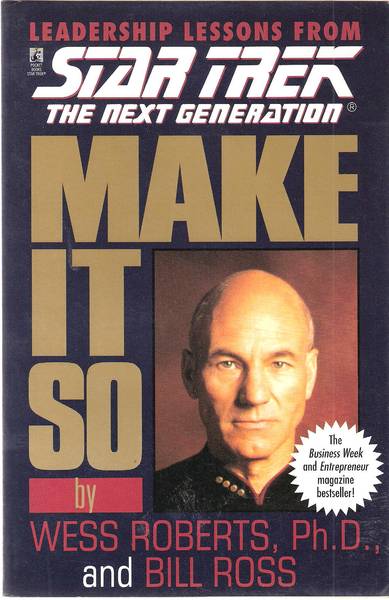
To be honest, this one isn’t a surprise. Star Trek fans are famously obsessive about their show. What I did find surprising was that the entire book was written as if it were Captain Jean-Luc Picard’s personal journal. This entry for example; “Captain’s personal journal: Observations on “Communication.” Stardate 45071.3 En route to Solarion IV.” (page 115). The entire book is written as a series of journal entries covering various missions and escapes in which the Captain was able to demonstrate his leadership skills. Not once does the book deviate from this style. The Captain even conveniently summarizes each journal entry with his own highlights about leadership (with the bold assumption that someone would actually make it to the end of a chapter). It contains almost no theory, very little practical advice, and even it’s title adage “Make it So” is never explained or expounded upon. All in all, this is one of the worst books on leadership you could hope to gag gift. Under no circumstance should you read this.
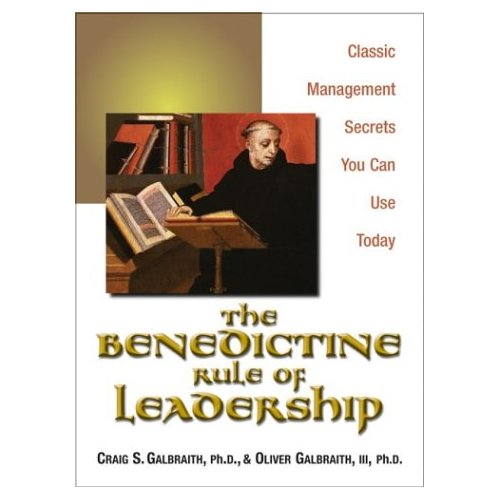
In general, I shied away from leadership models based on religious or historical figures. They typically fall into the “great man” theories of leadership which bestow almost supernatural powers to very mortal men (and they were always men). Not only do these theories typically ignore the complexities of historical context, but they place so much emphasis on innate character that leadership seems hardly worth developing. The Galbraiths eschew the second, but not the first by offering up the Rule of Saint Benedict, written for the administration of monastic living in southern Italy in 540 C.E. The problem is that running a monastery and running a modern organization have very little in common. Like the other authors, the Galbraiths spend so much time spinning straw into gold that they might have well just have written a book about their ideas of leadership rather than use a cover story.  Favorite line: “When, therefore, a guest is announced, let him be met by the Superior and the brethern  with every mark of charity. And let them first pray together, and then let them associate with one another in peace. This kiss of peace should not be given before a prayer hath first been said, on account of satanic deception.” (page 168). Read this if you’re the kind of person who understands what the hell that last sentence meant.

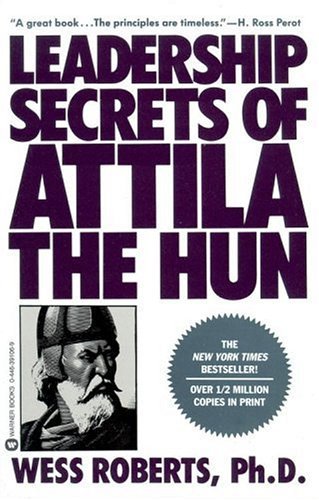
leadership-secrets-of-attila

This is actually Wes Roberts second appearance on the list (he also wrote Make it So: Leadership Lessons from Star Trek) and following the Sopranos before it, the subject of this book is infamous for his ruthlessness. Strange nominations for models of leadership, these gangsters and tyrants prove that the power to lead doesn’t require good intentions. But that’s not my biggest problem with this book. I tried to avoid books on historical figures because they at least provide a little history lesson, but this book warrants its place on my list simply because of its historical inaccuracy.  It reminds me of the great line by Moses Hadas, “This book fills a much needed gap.” There is nothing here but a series of leadership platitudes that are (thankfully) only loosely connected to Attila’s story. Read this if you are planning on becoming an author but fear that your ideas are far too stupid to ever get published.
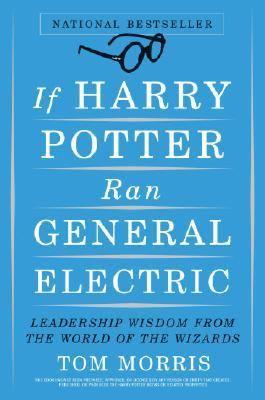
The book opens with this sentence, “ Wouldn’t it be more than a little strange if the bestselling children’s books in modern times contained some of the deepest wisdom that contemporary  business people  need for successful careers,  great relationships, and flourishing lives?” My answer is, “No, it’s not strange if you go looking for it.” I give this book some credit though, because using Harry Potter as a frame of reference is a smart choice. It’s an extremely popular story meaning that more people will be able to resonate with the leadership lessons. However, as with all of these models, the author has tried to bridge the gap between theory and story-telling, by writing a book that doesn’t do either very well. It’s equivalent to the old saying, “you can’t jump halfway across a hole.”  Either gives us logical insights for leaders or tell us a story that shows us leadership (as in the original Harry Potter). Trying to explain it all is like trying to explain the punchline of a joke. Favorite fact: Amazon’s shows that people who bought this also bought, “Trees of the Northern United States and Canada.” Read this if you’re the kind of person who would prefer to get cooking advice from Chef Smurf and tax advice from Scrooge McDuck.
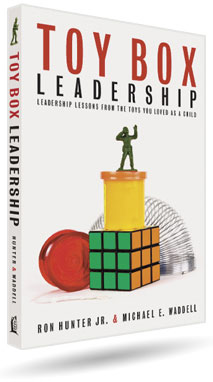
Toy Box Leadership mines children’s toys for leadership metaphors. It covers popular past times like the Slinky, Play-Doh, the yo-yo, the Rubik’s Cube, and even army men. I can’t help but think that time would be better spent watching the Toy Story trilogy. There are some great examples, like the connection between Light Brite as a way to demonstrate the ratio of signal to noise in a leader’s communication, but there is no fundamental leadership theory that supports it all. It’s just a la carte insights, which makes me wonder why you’d order from this menu of choices rather than a more conceptually robust meal that may actually connect to a large leadership development program. If you were looking for physical objects to supplement a workshop, then sure, this could be a useful book to help you identify some games. Favorite line: “You’ve probably seen it on a T-shirt or a bumper sticker: ‘He who dies with the most toys wins.’ It’s cute but false. The real truth about toys is this: when you live out the lessons these toys teach, you can win today.” It’s platitudes like this that make me question whether human evolution really exists or are we just running around in circles. Read this if you want to set up a coworker for a bet that you can get the boss to buy 100 Slinkies for the next corporate retreat.
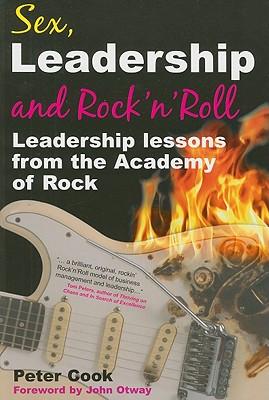
Sex, Leadership, and Rock & Roll certainly has a provocative title, but fails to fulfill that curiosity. The essential argument of this book is that we no longer live in the “orchestral age,” but rather a “rock-and-roll age,” in which our ideas of leadership should evolve accordingly. As a metaphor this is weak enough, but considering that the book was published in 2006 (rather than 1955) it makes me wonder just how many years the author had been working on it. Judging from passages like, “Leaders make and engage others with strategic decisions under conditions of high uncertainty of means, ends or both means and ends, (pg. 111)” I think he didn’t work quite long enough.  There are some unique gems including a list of “Rock tips for high performance,” which state without any further explanation  “get hair – in business this is called ‘grooming,'” “Build a massive wall in Berlin, a la Pink Floyd,” and ” Burn guitars after making love to them.” Of course it also includes the usual bromides about motivation, teamwork, decision-making, and vision presumably to help librarians decide where to shelve it. All in all, the whole thing reads like a bad acid trip, which is precisely as bizarre and as unsatisfying as it sounds. Read this if you run a methadone clinic for CEOs.

This is probably the best bad book on leadership I’ve ever read. For starters, the book is written in first person. As in, Santa Claus is speaking directly to the reader. “Another year, I had two reindeer come down with the flu right after Prancer pulled the plug, retired, and took off for Florida. That left me with a thirty-three percent delivery staff reduction (if you count Rudolph) with no immediate replacements (pg. 7).” Second, the book is filled with more empty aphorisms like “Make a list and check it twice,” and “listen to the elves.” There is not a single original thought in all of its 85 pages (the last 10 of which advertise the different “Santa Claus Leadership” courses and tools. There is truly nothing of value here, but I’m left wondering to whom were they marketing this book. Kids? Executives? I just don’t get it. Books like this lessen the credibility of leadership studies and frankly, they even lessen the credibility of Santa Claus. Read this if all other books have been burned up in an apocalyptic elf revolt and your gingerbread optometrist requires that you read something, anything, to maintain your vision.

So there you have it. 10 awful leadership models. What is it that compels us to see leadership lessons in everything that we do? Could it be that our need for true leadership has gotten so bad that we’d look to anything to find it? A horse, a make-believe wizard… Play-Doh? Is this really the best we can do?

MORE AWFUL LEADERSHIP

My Little Pony and Leadership

http://www.succeedtolead.org/pdfs/articles/leadership/pony_crawford.pdf

Viking Leadership
http://timmarks.com/blog/viking-leadership/

Five Leadership Lessons from Batman
http://www.forbes.com/sites/alexknapp/2012/07/30/five-leadership-lessons-from-christopher-nolans-batman-trilogy/

Leadership Lessons of Indiana Jones
http://www.refreshleadership.com/index.php/2011/11/lessons-indiana-jones/

4 Leadership Lessons from the Lord of the Rings
http://www.forbes.com/sites/geoffloftus/2012/07/18/4-leadership-lessons-from-aragorn/

Leadership Lessons from the Toilet Seat
http://www.perrynoble.com/blog/leadership-lessons-from-the-toilet-seat

Muppet Leadership
http://dailygenius.wordpress.com/2013/01/02/introducing-muppet-leadership/

Superhero Leadership
http://www.tonycooke.org/free_resources/articles_leadership/leadership_superheroes.html

Leadership Lessons of Kung FU Panda
http://grafsata.wordpress.com/2009/01/28/leadership-lessons-of-the-kung-fu-panda/

Shrek: Leadership Lessons
http://www.getnside.com/atx/magazine/business/032011/articles/2054-Shrek_A_True_Executive_Leader/

Pee Wee Herman and Leadership
http://www.starkscommunications.com/speechwriting/speechwriter-embraces-pee-wee-hermans-philosophy/

Leadership Lessons from Moby Dick
http://www.inc.com/samuel-bacharach/your-own-private-whale-leadership-lessons-from-moby-dick.html

Six Leadership Lessons from Deadliest Catch
http://www.forbes.com/sites/forbesleadershipforum/2012/10/19/six-leadership-lessons-from-the-crews-on-deadliest-catch/

Leadership Lessons from the Godfather
http://www.fastcompany.com/1826672/offer-you-cant-refuse-leadership-lessons-godfather

Star Wars Leadership Lessons
http://www.forbes.com/sites/erikaandersen/2012/02/24/star-wars-leadership-lessons-even-geeks-need-guidance/

Late Bloomers

22 Mar

The following is excerpted from Malcolm Gladwell’s 2008 article “Late Bloomers.”

Ben Fountain was an associate in the real-estate practice at the Dallas offices of Akin, Gump, Strauss, Hauer & Feld, just a few years out of law school, when he decided he wanted to write fiction. The only thing Fountain had ever published was a law-review article. His literary training consisted of a handful of creative-writing classes in college. He had tried to write when he came home at night from work, but usually he was too tired to do much. He decided to quit his job.

“I was tremendously apprehensive,” Fountain recalls. “I felt like I’d stepped off a cliff and I didn’t know if the parachute was going to open. Nobody wants to waste their life, and I was doing well at the practice of law. I could have had a good career. And my parents were very proud of me—my dad was so proud of me. . . . It was crazy.”

He began his new life on a February morning—a Monday. He sat down at his kitchen table at 7:30 a.m. He made a plan. Every day, he would write until lunchtime. Then he would lie down on the floor for twenty minutes to rest his mind. Then he would return to work for a few more hours. He was a lawyer. He had discipline. “I figured out very early on that if I didn’t get my writing done I felt terrible. So I always got my writing done. I treated it like a job. I did not procrastinate.” His first story was about a stockbroker who uses inside information and crosses a moral line. It was sixty pages long and took him three months to write. When he finished that story, he went back to work and wrote another—and then another.

In his first year, Fountain sold two stories. He gained confidence. He wrote a novel. He decided it wasn’t very good, and he ended up putting it in a drawer. Then came what he describes as his dark period, when he adjusted his expectations and started again. He got a short story published in Harper’s. A New York literary agent saw it and signed him up. He put together a collection of short stories titled “Brief Encounters with Che Guevara,” and Ecco, a HarperCollins imprint, published it. The reviews were sensational. The Times Book Review called it “heartbreaking.” It won the Hemingway Foundation/pen award. It was named a No. 1 Book Sense Pick. It made major regional best-seller lists, was named one of the best books of the year by the San Francisco Chronicle, the Chicago Tribune, and Kirkus Reviews, and drew comparisons to Graham Greene, Evelyn Waugh, Robert Stone, and John le Carré.

Ben Fountain’s rise sounds like a familiar story: the young man from the provinces suddenly takes the literary world by storm. But Ben Fountain’s success was far from sudden. He quit his job at Akin, Gump in 1988. For every story he published in those early years, he had at least thirty rejections. The novel that he put away in a drawer took him four years. The dark period lasted for the entire second half of the nineteen-nineties. His breakthrough with “Brief Encounters” came in 2006, eighteen years after he first sat down to write at his kitchen table. The “young” writer from the provinces took the literary world by storm at the age of forty-eight.

“It’s never too late to be what you might have been.”  -George Eliot

Conscious Leadership or Leader Consciousness?

20 Mar

Up until a month ago, the term “conscious leadership” was new to me. However, as I’ve immersed myself in the literature and community, it’s become clear that while it may be a new term, it was not a new concept. I’ve been studying the great contemplative traditions for a long time and they in turn have exploring the boundaries of consciousness for thousands of years. So, while the term may be new, the truth it points to certainly isn’t. The benefit comes from the fact that conscious leadership is taking these mystical insights, integrating them with the best research and theory from organizational and leadership studies, and wrapping them it all up in business language that Westerners can stomach.

I think it’s a step in the right direction, but it also means that some things might be lost in translation. The sheer complexity of consciousness studies is awe-inspiring. The history of the great mystical traditions is overwhelming by itself. Then you add the important insights from philosophy of mind, and more recent contributions from good old cognitive-development psychology, and you have this massive amount of great information to pull together. And this is before you add all of the crappy information.

Now, I’m not one of those people who says that you shouldn’t even bother trying to define words like “consciousness” or “leadership.” Trying to define the words you use is an important exercise. It forces us to make difficult choices and create elegant solutions. So, for the purposes of this article, I’d like to offer my own definitions of both and see where that takes us:

Consciousness – The state of being aware of sensory forms (both internal and external).

Leadership – The process of intentional influence of one person upon others.

You’ll notice a few things. First, they are short definitions. This is because I believe that simplicity amplifies meaning. Second, notice that neither of these definitions includes a moral dimension. This is because I believe that the distinction between TRUE and FALSE is much more relevant than GOOD versus BAD. Third, the two primary verbs are awareness and influence. When we put these two definitions together, we start to see that conscious leadership is primarily about the ability to be aware and the ability to influence based on that awareness.

Now, most leadership models would have you believe that you need to be aware FIRST, then you influence others (this would be accurate linguistically because “conscious” modifies “leadership”). This would certainly fit the hero-style leadership models of the past. The leader is worshiped as an omnipotent deity and the central lever when it comes to organizational change. But we know that this is only one side of the coin. The primary focus on the individual is often shorthanded as “leader development” and the collective focus is often called, “leadership development.” The whole of the field is then called, confusingly, “leadership development.” Clearly, we need to do a better job with our definitions.

The field of conscious leadership seems to be a bit confused on this point. Conscious leadership is used almost exclusively to mean the individual awareness of a leader. I would like to submit that there should be an equal focus on “leader consciousness,” which would be the collective counterpart. As much as I respect the efforts of thought leaders in conscious leadership, I think it sells itself short if it just repackages ancient wisdom. It’s a noble service on it’s own, but it won’t really contribute to the leadership literature if it doesn’t expand its questions. What would collective leader consciousness look like? How would it operate? To me, these are far more interesting questions.

Five Simple Rules for the Successful Entrepreneur

13 Mar

Stanford professor Tom Byers knows a lot about starting companies. His expertise is in high-technology ventures and serves as the faculty director for the Stanford Technology Ventures Program and the prestigious Mayfield Fellows Program (MFP). As an early employee of both Go Corporation and Symantec and an expert in what works and what doesn’t when trying to start a company, Byers offers the following five rules as essential for would-be Zuckerbergs:

1. Show up on time

2. Be nice to people

3. Do what you say you’ll do

4. Deliver more than you promise

5. Work with enthusiasm and passion

These five rules won’t give you all the answers for how to be a successful entrepreneur, but they are essential and elegant.

Lower Your Standards

10 Mar

stafford

The poet William Stafford used to rise every morning at four and write a poem. Somebody said to him, “But surely you can’t write a good poem every day, Bill. What happens then?” “Oh,” he said, “then I lower my standards.”

Mary Rose O’Reilley, Radical Presence.

“…No One Need Wait a Moment…”

8 Mar

anne_2148996b

“How lovely to think that no one need wait a moment, we can start now, start slowly changing the world! How lovely that everyone, great and small, can make their contribution toward introducing justice straightaway… And you can always, always give something, even if it is only kindness!”
– The Diary of Anne Frank