Archive | Personal RSS feed for this section

Radical Acceptance

25 Feb

I just got back from the BOLD Academy in San Francisco and I came away from that experience with a renewed appreciation for the personal change process. I’ve tried to capture that insight below. First of all, what I’m trying to describe is a little nuanced (but infinitely practical) so if it doesn’t make sense, then feel free to blame the messenger. Second, it’s equally likely that you’ll get it and won’t agree with it. That’s fine too. Please let me know what you’re thinking in the comments below. I’d like my ideas to most fully represent the truth and we all have important pieces of it.
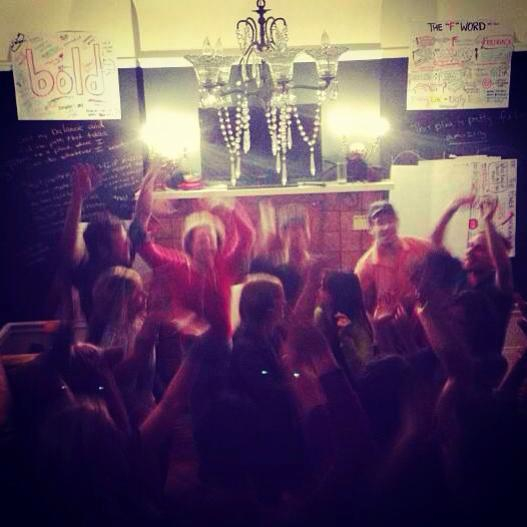
dancing-at-bold

The BOLD house vibrated with energy, but underneath that energy was a community of radical acceptance and support.

I’m ambitious. And if you’re like me then you know that setting and achieving goals is one of the most pleasurable feelings in the world. I love the challenge of pushing myself beyond my limits, failing, and getting up again. And again. And again. This type of grit got me through my tough times and I certainly wouldn’t have succeeded if I didn’t have a compelling purpose pulling me forward. But recently I’ve realized the limitations of this way of thinking. I’ve spent so much time being pulled forward by purpose and trying to overcome obstacles that I’ve failed to notice something else. The world was no longer the same. Change happens so radically today that my dream job may be obsolete by the time I even start a two-year plan to get it. Careers, businesses, and even entire markets are created and destroyed from month to month. So, I began to realize that I needed a new way of doing things. I think the problem is simply that my ego-driven mindset restricts me from making necessary adjustments to an ever-changing reality. I simply don’t know when a danger sign is just self-doubt (and I should push through it) or when it signals that I need to make an actual change in our approach. So, how do you know the difference?

Well, I have a guess. I think the method for knowing the difference is intuitive rather than intellectual. It is something I’m calling radical acceptance and the idea is pretty simple. If you are resisting your own thoughts or feelings then you are not acknowledging reality and the only way to stop compulsive resistance is start accepting – everything. The reason it’s called “radical” acceptance is because it accepts everything…including resistance itself. Confused? I was too. Here is an story of how this shows up.

A friend and I had just finished a yoga class together and a few minutes later I found her crying. She said that during the mindfulness practice, she finally became aware of all of the negative self talk in her head. The voices that told her she wasn’t good enough. The voices that said she needed to try harder. Her practice had opened up new insight, but as she told me this amazing revelation she became increasingly upset. “I just can’t believe how much of my time I’ve wasted,” she said. “These negative voices in my head have been holding me back this whole time. They tell me that I’m not good enough and I can’t believe that I listened to them.” As she embellished how her negative self talk had been such an awful thing and how she needed to get rid of it. I said, “that’s an amazing insight, but be careful that you don’t beat yourself up for beating yourself up.” She paused and smiled.

My point was that your ego will adapt to whatever thing you fear. If you fear being poor then it will make you feel bad for not making enough money. If you fear being selfish then it will make you feel bad for buying designer shoes. If you fear being superficial then it will make you feel bad for skipping yoga class. Resistance will always tell you that you are not centered enough or not being generous enough or not being spiritual enough. Know that it is all just your ego using resistance against you. And just like you cannot fight darkness with darkness, you cannot fight resistance with resistance. And underneath all of the surface level problems you are facing, the real problem is resistance itself.

dark-room-light-through-window-hunched-man1 PAINT(1)

You cannot fight darkness with darkness.

So, radical acceptance is deeper than just awareness. My yoga friend was aware of the negative self talk, but she had not yet accepted it. She was using negative self talk to keep herself from using negative self talk. It is silly, but also tragic. We instinctively move towards happy feelings and move away from negative feelings. We rarely stop and accept them as they are. Radical acceptance is such an effective approach because it isn’t about moving towards or away. It isn’t about compulsive action at all. When you accept everything as it is without an agenda then your actions will be aligned. When your actions are aligned things will change organically. It’s a complete paradigm shift.

Unconditional acceptance as a means for change is a radical notion, but one that ultimately frees us to walk confidently through the fog of attachments. It’s a little nuanced, but I think that’s the point. Our ego is fueled by resistance largely because, according to neurologists, the brain’s primary function is to curate reality. It’s primary function is to delete information from your awareness. So, if you practice a form of radical acceptance training (meditation, mindfulness, yoga, etc.) then you can offset your inborn brain/ego/curator/resistance machine that blinds you to what’s really happening. If you don’t, then you’ll be living in black and white (which, since we are radically accepting, isn’t a bad thing…it’s just a thing).

So, be careful with the goal-setting workshops and all of the stories about what you are supposed to want. Start by becoming aware of your thoughts and feeling and start by accepting them. If you don’t want to accept them, then accept that feeling. If that thought makes you feel angry. Accept that feeling. If it makes you feel bored, then accept that feeling. If it makes you hungry, then go make a sandwich. Remember that love must be unconditional or it isn’t love. so if you’re going to really love yourself then you need to accept everything about yourself, every moment. The key point is that even when you don’t want to accept something, you can still accept the feeling of non-acceptance.

2012.07.09 acceptance

Love is unconditional or it isn’t love.

Again, the ego is fueled by resistance and it will trick you into thinking that you need to DO something to feel love or find peace. Radical acceptance neutralizes this with grace and elegance. You don’t need to do anything to radical accept. It starts the moment you’re ready for it to start and paradoxically, when that happens you’ll find love and peace (and money and whatever else you really needed). The therapist Carl Rogers said it this way, “It seems to me to have value because the curious paradox is that when I accept myself as I am, then I change. I believe that I have learned this from my clients as well as within my own experience – that we cannot change, we cannot move away from what we are, until we thoroughly accept what we are. Then change seems to come about almost unnoticed.” (The Carl Rogers Reader, pg. 19)

Radical acceptance as a means for change is about being centered not being pushed or pulled. And we all learned in high school physics that when weight is centered it reduces the object’s moment of inertia making it easier and faster to change direction. If you want to survive the pace of radical change, then you need to center yourself and accept the most current reality. Both in your environment and inside yourself. With complete acceptance of reality you will be free of compulsion. You will be free to act when you need to act. You will be free to rest when you need to rest. Paradoxically, it is only when you radically accept things as they are that you or your organization can respond appropriately to the ever-changing demands of modern life.

In 1906, the South African newspaper Indian Opinion held a competition to define the growing resistance against British rule. Gandhi famously adapted one of the entries – “satyagraha” – to define his vision of social change. We often think about acceptance as a passive act and RADICAL acceptance even more so. But Gandhi never liked the terms “passive resistance” or even “non-violent resistance.” In fact, satyagraha means “insistence on truth.” So, radical acceptance isn’t about change. It is foremost about truth. And yet, magically, it is through accepting truth that we change.   

Why Artists Go Crazy

21 Jan

tom_cruise-600

We know the stories. The alcoholic musician. The chair-jumping actor. Of course there are many reasons why these characters take a weird turn. Sure genetics and personality are risk factors, but I think there is one particular and under-appreciated reason. Artists go crazy because our education system teaches them to be crazy.

The world teaches everyone to be responsible. Get a good job. Find a husband. Buy an Audi. However, artists take a different path. They ignore this advice. They grow up on a curriculum of creation, risk, and rejection. Their teachers are the audience. They are graded by applause (or lack thereof).

Educator reformer Ken Robinson said, “…this is exactly why some of the most successful people you’ll ever meet didn’t do well at school. Education is the system that’s supposed to develop our natural abilities and enable us to make our own way in the world. Instead, it is stifling the individual talents and abilities of too many students and killing their motivation to learn.”

So, if the artist is going to be successful she must learn to ignore advice. She must learn to trust in her own intuition above that of the expert, because the expert’s allegiance is to the status quo.  Teachers. Friends. Family. They may even have good intentions, but the system itself does not encourage impractical pursuits. So what happens to the artist?

He learns that common sense doesn’t make a lot of sense. Advice doesn’t have a lot of value and that sanity is oppression. Is it any wonder that artists go crazy? Is it any wonder that we want to be like them?

Productivity Hack #1 – Stick to a Routine (Here’s Mine)

3 Jan

Productivity is a hot topic and there is going to be a lot of crap floating around about it. Well, I’m not one to let that opportunity go by…so, here is my crap advice: stick to a routine. Obviously, it’s important to stick to the RIGHT kind of routine (even a couch potato is very consistent) and while there is a lot of helpful ideas out there, I’m going to stick with the ones that I actually use myself. In my opinion, there is nothing more important than my routine. Here is my typical day…

– Wake up around 4:15-4:45 am.

– Turn my Up band to awake mode.

– Bathroom. Read book or read news on iPhone.

– Kitchen. Drink big glass of water.

– Get ready for gym, leave house, return home for wallet.

– Workout. Weights and cardio on alternating days. I still follow Body-for-Life workout primarily.

– Come home. Eat Diet-to-go breakfast. Drink more water. Take vitamins. Make coffee.

– Read. I usually have about 5-7 books that I’m reading. Almost all non-fiction. I usually complete about 2-3 a week. Recent examples, Drive by Daniel Pink, The Alchemist by Pedro Coelho, The Big Leap by Gay Hendricks, Self-Compassion by Kristin Neff, The Power of Full Engagement by Loehr and Schwartz, Real Happiness by Sharon Salzberg.

– Shower. Get dressed. I work from home mostly, so this part can vary depending on appointments.

– Home office. Pick up notepad and review/add to it. I follow David Allen’s Getting Things Done approach. I organize my tasks through Google tasks, I use my calendar only for things that are happening that day, and I use a basic legal pad for my daily stuff and ideas. As I go I write down stuff for the next day meaning that I can pick it up in the morning and pretty much get started. Usually I do a review and add to it.

– I typically work from about 6:30 am to about 9:30 am without a break. My wife is often up by this time so we have breakfast.

– Back to work from about 10:00 am to lunch time, which can vary. I usually try to get through everything that needs to get done by lunch.

– Eat Diet-to-go lunch. Watch part of a movie, errands, or read.

– I usually work in a little meditation in the afternoon. Not long (or not as long as I probably should). Usually 12 minutes.

– Home office. Check in on emails. Review legal pad of to-dos. Add some more. Cross some more off. It’s pretty much a dance I do all day. Adding and crossing off as my work demands.

– My brain is usually mush around 3:00 pm for anything that I’m not completely excited about (that’s the downside to being a knowledge worker). But by this point, I’ve already put in an 8-hour day.

– The rest of my day is playtime. Although since I love what I do, I typically put in a little more work on the things that I’m excited about. I read some more, go to a movie theater, or just kill time around the house. Occasionally, I meet up with friends, but again, not as often as I would like (9-5 jobs keep you busy!).

– I eat dinner around 6:00 pm. I log meals and exercise on my Up band as I go.

– I usually start to set up tomorrow by about 7:00 pm. I make sure I write down things that need to get done.

– I finish my day by spending time with my family. Reading or watching TV.

– Set Up band to sleep mode. Fall asleep by 9:30pm.

So, there you go. That’s my basic routine. Now, I’m a morning person (and have worked hard to become so), so take from this what you will. In my opinion, my routine is one of my strongest supports. It ensures that I take care of the stuff that is important to me before it becomes urgent. My health, my career, my family, my soul are all cared for. Every day.

The Only 2013 Resolution You Should Have – Get Better at Sticking to Commitments

2 Jan
Image

You’ll have to make your resolution several times.

A person’s future success can be predicted by his or her ability to start over. It is the single greatest factor above hard work, having goals, or having the right resources (what Harvard researches came to call “grit”). The ability to start over when things go south (and they will) means that you let go. You let go of the stories about why you can’t do something. You simply made a mistake and you move on….but it also means that you start over with the knowledge that the process is the key. Goals are great and extrinsic motivation can be helpful (but Daniel Pink’s book Drive makes it clear that it rarely is), but we often set out with the false hope that our destinations will be easy to reach or that when we encounter future challenges that we will face them with the same level of energy and motivation that we have right now. The fact is that you are running on a limited resource. Research tells us that your self-discipline can run out and just because you feel a surplus now doesn’t mean you’ll have it in a few weeks (when most people give up). So, if you don’t want to be like everyone else, then play a different game. Don’t focus as much on building up your motivation NOW….you probably already have plenty. I know it feels good to celebrate the DECISION to change your life, but if you don’t actually follow through on that decision then you haven’t done anything. It’s the cycle that keeps everyone trapped (it’s the same when a young person proudly tells you he is “thinking about going to law school”).

Everyone knows that a resolution is a commitment, but what they don’t realize is that it is actually  a series of commitments. You have to make this resolution several times and each time you are beginning the process again. It’s like training your commitment muscles (or more accurately neurological patterns in the brain), which make it easier and easier to follow through as you progress. So no matter what external goal you have right now (get a better job, lose weight, find a partner) in reality the most important goal you can have is “improve my ability to achieve goals.” The way you do that is by making your resolutions and make them several times. It’s easier to start things off with a clean slate. Everyone wants to be perfect. But how will you feel when you’ve stumbled a bit? How will you feel with a few mistakes? You can’t be perfect anymore, so you’ll have to learn to work with what you have. Most people can’t face that reality, so they give up. Sadly completing their self-fulfilling prophecy. Remember that the 1906 Chicago Cubs had the best baseball season in history but still lost about a quarter of their games. If you really want to change your life this year, then commit to getting better with commitments. Lesson #1, 2, and 3…apply selective amnesia…forget your mistakes. Silence the internal voice of resistance and learn to begin again.

A Stranger Gave Me $45,000

31 Dec

In 2004, someone I don’t know just gave me $45,000. I didn’t expect it. I didn’t even ask for it. In truth, I didn’t do anything special to deserve it. Here is what happened.

At the time, I was a graduate student at Harvard Divinity School. I was extremely active with extracurriculars….student council president, editor of school paper, school tour guide, class marshall, etc….blah, blah, blah…the point is I was everywhere. Call it an overdeveloped sense of responsibility or pure boredom; I was just trying to make things better. One day in the late spring of 2004, I walked down to my student mailbox and pulled out an envelope with my name on it. Typed out on 8.5 X 11 paper in 12-point Times New Roman font, there was a letter…

photo

I still have the letter hanging in my office.

—-

May 5, 2004

Dear Chris –

I hope you do not think it presumptuous on my part, however I wanted to let you know that I have taken the liberty of providing for assistance toward your tuition and certain other living expenses associated with your last year as a Master of Divinity student at HDS [Harvard Divinity School].

I feel truly blessed with this opportunity to be of some assistance to you as you prepare for the journey ahead. In return, my only wish is that upon graduation you will consider channeling your vast potential in a way that can help relieve the pain and suffering of others, particularly those in the more disadvantaged layers of our society.

In the meantime, please accept my best wishes for the highest measure of success and fulfillment now and for the years ahead.

I remain forever,

A Friend

Please make an appointment with Bob Coughlin, Coordinator of Financial Aid, at your earliest convenience in order that your grant award can be finalized.

Now, I didn’t really pay much attention to the letter when I read it. I didn’t know if it was a joke or really what it even meant. Luckily, my journey to find answers ended just upstairs in the financial aid office. I entered, asked to see Bob Coughlin, and sat down in his office. Bob then explained to me that someone, he could not reveal who, had paid for my last year of tuition at Harvard. In addition, this person included a sizable stipend for living expenses on top of that tuition. I was floored. Never in my life have I felt that emotion. It was a mixture of pride and embarrassment. The total award came to a little over $45,000. Just handed to me with the hope that I would channel my potential to relieving the pain and suffering of others. It’s quite an expectation to put on an ambitious Harvard student, but it remains a guiding light for me.

As I walk forward into 2013, I’m reminded of all those who have helped me along my path. Thank you.