Archive | Life RSS feed for this section

Can You Hear the Mountain Stream?

4 Mar

Image

A Zen Master was walking in silence with on of his disciples along a mountain trail. When they came to an ancient cedar tree, they sat down under it for a simple meal of some rice and vegetables. After the meal, the disciple, a young monk who had not yet found the key to the mystery of Zen, broke the silence by asking the Master, “Master, how do I enter Zen?”

He was, of course, inquiring how to enter the state of consciousness which is Zen.

The master remained silent. Almost five minutes passed while the disciple anxiously waited for an answer. He was about to ask another question when the Master suddenly spoke. “Do you hear the sound of that mountain stream?”

The disciple had not been busy thinking about the meaning of Zen. Now, as he began to listen to the sound, his noisy mind subsided. At first he heard nothing. Then, his thinking gave way to heightened alertness, and suddenly he did hear the hardly perceptible murmur of a small stream in the far distance.

“Yes, I can hear it now,” he said.

The Master raised his finger and, with a look in his eyes that in some way was both fierce and gentle, said, “Enter Zen from there.”

The disciple was stunned. It was his first satori – a flash of enlightenment. He knew what Zen was without knowing what it was that he knew!

They continued on their journey in silence. The disciple was amazed at the aliveness of the world around him. He experienced everything as if for the first time. Gradually, however, he started thinking again. The alert stillness became covered up again by mental noise, and before long he had another question. “Master,” he said, “I have been thinking. What would you have said if I hadn’t been able to hear the mountain stream?” The Master stopped, looked at him, raised his finger and said, “Enter Zen from there.”

Excerpted from Eckhart Tolle’s A New Earth (2005, pg. 236-238).

Welcome to the Studio

3 Mar

Image

Welcome to the Studio. Please watch your head. We have canvas and paints and brushes. We have walls and lights and warmth. You have all the space you need. Your work here is your own.  Your time here will be short, so make the most of it.

Radical Acceptance

25 Feb

I just got back from the BOLD Academy in San Francisco and I came away from that experience with a renewed appreciation for the personal change process. I’ve tried to capture that insight below. First of all, what I’m trying to describe is a little nuanced (but infinitely practical) so if it doesn’t make sense, then feel free to blame the messenger. Second, it’s equally likely that you’ll get it and won’t agree with it. That’s fine too. Please let me know what you’re thinking in the comments below. I’d like my ideas to most fully represent the truth and we all have important pieces of it.
dancing-at-bold

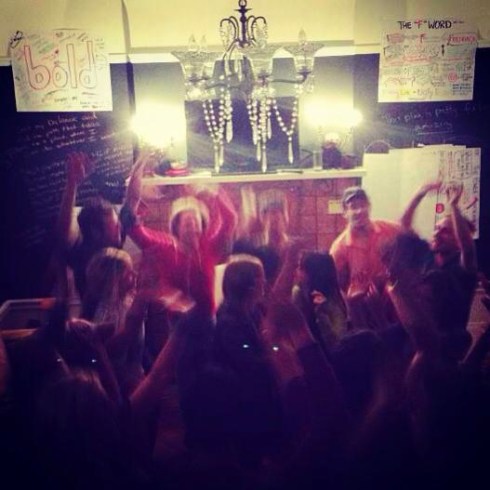
The BOLD house vibrated with energy, but underneath that energy was a community of radical acceptance and support.

I’m ambitious. And if you’re like me then you know that setting and achieving goals is one of the most pleasurable feelings in the world. I love the challenge of pushing myself beyond my limits, failing, and getting up again. And again. And again. This type of grit got me through my tough times and I certainly wouldn’t have succeeded if I didn’t have a compelling purpose pulling me forward. But recently I’ve realized the limitations of this way of thinking. I’ve spent so much time being pulled forward by purpose and trying to overcome obstacles that I’ve failed to notice something else. The world was no longer the same. Change happens so radically today that my dream job may be obsolete by the time I even start a two-year plan to get it. Careers, businesses, and even entire markets are created and destroyed from month to month. So, I began to realize that I needed a new way of doing things. I think the problem is simply that my ego-driven mindset restricts me from making necessary adjustments to an ever-changing reality. I simply don’t know when a danger sign is just self-doubt (and I should push through it) or when it signals that I need to make an actual change in our approach. So, how do you know the difference?

Well, I have a guess. I think the method for knowing the difference is intuitive rather than intellectual. It is something I’m calling radical acceptance and the idea is pretty simple. If you are resisting your own thoughts or feelings then you are not acknowledging reality and the only way to stop compulsive resistance is start accepting – everything. The reason it’s called “radical” acceptance is because it accepts everything…including resistance itself. Confused? I was too. Here is an story of how this shows up.

A friend and I had just finished a yoga class together and a few minutes later I found her crying. She said that during the mindfulness practice, she finally became aware of all of the negative self talk in her head. The voices that told her she wasn’t good enough. The voices that said she needed to try harder. Her practice had opened up new insight, but as she told me this amazing revelation she became increasingly upset. “I just can’t believe how much of my time I’ve wasted,” she said. “These negative voices in my head have been holding me back this whole time. They tell me that I’m not good enough and I can’t believe that I listened to them.” As she embellished how her negative self talk had been such an awful thing and how she needed to get rid of it. I said, “that’s an amazing insight, but be careful that you don’t beat yourself up for beating yourself up.” She paused and smiled.

My point was that your ego will adapt to whatever thing you fear. If you fear being poor then it will make you feel bad for not making enough money. If you fear being selfish then it will make you feel bad for buying designer shoes. If you fear being superficial then it will make you feel bad for skipping yoga class. Resistance will always tell you that you are not centered enough or not being generous enough or not being spiritual enough. Know that it is all just your ego using resistance against you. And just like you cannot fight darkness with darkness, you cannot fight resistance with resistance. And underneath all of the surface level problems you are facing, the real problem is resistance itself.

dark-room-light-through-window-hunched-man1 PAINT(1)

You cannot fight darkness with darkness.

So, radical acceptance is deeper than just awareness. My yoga friend was aware of the negative self talk, but she had not yet accepted it. She was using negative self talk to keep herself from using negative self talk. It is silly, but also tragic. We instinctively move towards happy feelings and move away from negative feelings. We rarely stop and accept them as they are. Radical acceptance is such an effective approach because it isn’t about moving towards or away. It isn’t about compulsive action at all. When you accept everything as it is without an agenda then your actions will be aligned. When your actions are aligned things will change organically. It’s a complete paradigm shift.

Unconditional acceptance as a means for change is a radical notion, but one that ultimately frees us to walk confidently through the fog of attachments. It’s a little nuanced, but I think that’s the point. Our ego is fueled by resistance largely because, according to neurologists, the brain’s primary function is to curate reality. It’s primary function is to delete information from your awareness. So, if you practice a form of radical acceptance training (meditation, mindfulness, yoga, etc.) then you can offset your inborn brain/ego/curator/resistance machine that blinds you to what’s really happening. If you don’t, then you’ll be living in black and white (which, since we are radically accepting, isn’t a bad thing…it’s just a thing).

So, be careful with the goal-setting workshops and all of the stories about what you are supposed to want. Start by becoming aware of your thoughts and feeling and start by accepting them. If you don’t want to accept them, then accept that feeling. If that thought makes you feel angry. Accept that feeling. If it makes you feel bored, then accept that feeling. If it makes you hungry, then go make a sandwich. Remember that love must be unconditional or it isn’t love. so if you’re going to really love yourself then you need to accept everything about yourself, every moment. The key point is that even when you don’t want to accept something, you can still accept the feeling of non-acceptance.

2012.07.09 acceptance

Love is unconditional or it isn’t love.

Again, the ego is fueled by resistance and it will trick you into thinking that you need to DO something to feel love or find peace. Radical acceptance neutralizes this with grace and elegance. You don’t need to do anything to radical accept. It starts the moment you’re ready for it to start and paradoxically, when that happens you’ll find love and peace (and money and whatever else you really needed). The therapist Carl Rogers said it this way, “It seems to me to have value because the curious paradox is that when I accept myself as I am, then I change. I believe that I have learned this from my clients as well as within my own experience – that we cannot change, we cannot move away from what we are, until we thoroughly accept what we are. Then change seems to come about almost unnoticed.” (The Carl Rogers Reader, pg. 19)

Radical acceptance as a means for change is about being centered not being pushed or pulled. And we all learned in high school physics that when weight is centered it reduces the object’s moment of inertia making it easier and faster to change direction. If you want to survive the pace of radical change, then you need to center yourself and accept the most current reality. Both in your environment and inside yourself. With complete acceptance of reality you will be free of compulsion. You will be free to act when you need to act. You will be free to rest when you need to rest. Paradoxically, it is only when you radically accept things as they are that you or your organization can respond appropriately to the ever-changing demands of modern life.

In 1906, the South African newspaper Indian Opinion held a competition to define the growing resistance against British rule. Gandhi famously adapted one of the entries – “satyagraha” – to define his vision of social change. We often think about acceptance as a passive act and RADICAL acceptance even more so. But Gandhi never liked the terms “passive resistance” or even “non-violent resistance.” In fact, satyagraha means “insistence on truth.” So, radical acceptance isn’t about change. It is foremost about truth. And yet, magically, it is through accepting truth that we change.   

Life Doesn’t Get a Montage (You Don’t Get to Skip the Boring Parts)

31 Jan
Already sees in 3D

This guy already sees in 3D

We all love movies. We learn about a hero. His challenges and his desires. He sets off on a path only to be met with failure. Again and again he fails. Resistance come from all sides. Finally and inevitably, he realizes that he must change himself. He turns the corner by letting go of who he thought he was. He must become someone new. His desire has changed. He no longer wants we he did at the beginning. He wants something deeper. More noble. In the end he rises up and achieves his new goal. He wins. And we are all uplifted.

This is the typical narrative progression. One that screen-writer Robert McKee  coaches and one in which Stanford University has dedicated significant resources to teach (i.e. The Stanford Storytelling Project). This structure has stood the test of time because it so accurately represents the human development process that we experience ourselves. The theater needn’t be filled with cognitive-developmental psychologists for it to appreciate how natural and beautifully dynamic this process is. We’ve all had our own moments. Ambitions thwarted. Insights gained. New life received. We’ve all tasted it (on some level). And we keep buying tickets for more.

However, the way  the hero stories are told in the movies is not a perfect one-to-one translation. Within only 120-minutes at their disposal, screen writers and directors must make hard decisions about what to include and how to show it. This is where we have a problem. Far from being light-hearted entertainment, movies have come to define how we learn and think about ourselves and our world. Students learn more about  Greek mythology from watching Harry Potter than from reading Edith Hamilton (She was required reading in school for decades, so if you don’t get that reference, then you prove my point). The narrative structure as presented in movies is the gestalt of our times. It informs how we make sense of our lives. How we think about our relationships. How we think about our own stories. And I think there is one movie convention that sends all the wrong messages – the montage.

As you know, the montage is a series of short clips meant to speed up time/space for the audience. It allows a writer to show lots of action in a short amount of time. This is great for popcorn sales. However, the montage subtly misrepresents how change actually happens. One that, without some attention, may suggest that achieving your dreams is going to be easy. It isn’t an overt promise, but a slight suggestion. The hero’s brutal 6-month recovery.  The community comes together to save the hospital. The painter locks herself away in her studio. All of them only last about 60 seconds. Here’s how the movie Team America handled this phenomena (in case you weren’t already thinking about this):

Obviously, in real life these things take time and courage, but more than that they take resolve and persistence. The problem with the montage is that it skips over the most important part of achieving our goals. The work. The boring and gritty work that it takes to get from point A to B. The montage suggests, by the real estate afforded it, that hard work isn’t really all that  important. By sheer ratio alone, the main characters moment of transformation (the moment the entire narrative is based upon) is usually only a few seconds. The entire movie has built up to this transformation, which it then quickly glances over. Some action happens and then we are then hurriedly ushered into the movies closing scenes. The white wedding. The reluctant apology. The blood-stained trophy raised to a cheering crowd.

The point is that we’re usually pretty good at accepting things that are easy. We’re also pretty good at accepting things that are hard. But we usually really suck at accepting things that are boring. The parts where the hero toils in silence. Working day after day. Grinding out the work that she so desperately needs to finish. She cooks the family dinner then she studies. She cooks dinner then she studies. She cooks dinner then she studies. Day after day. She cooks dinner then she studies. She cooks dinner then she studies. Night after night. Slowing working on her degree. It’s repetitive. It’s boring. But she puts one foot in front of the other and carries on. She is too focused. She cooks dinner then she studies. It would be a horrible movie.

* clang…..clang…..clang…..

The reason is because real work is boring. It is repetitive and bland. Sure there are moments when you might let a smile slip out (or a tear), but real work…the kind that the movies dramatize in the montage…is deep work. It is about becoming more than you were. About becoming someone new and that isn’t going to be obvious to other people. You can’t point to it. It is deeper than your emotions. It isn’t always going to be showy or fun or glamorous. When you’re on the path you’re on it alone. Personal transformation cannot be outsourced. No one can do it for you.

And yet we’ve become conditioned to “achieve” that if we’re told that something is “difficult” or “hard” then we immediately pound our chest and roar, “Bring it on motherfucker!!” But this is a conditioned response. We’ve watched too many movies. Our culture programs us to turn hardship into meaning. Difficultly into challenge. “Me against the World” should probably be on the dollar bill. But this is only one side of the coin. Many people can handle HARD, CHALLENGE, FEAR, COURAGE, ROAR!!!, but far fewer can handle BORING, COLD, GRITTY, GRIMY, MEH. We haven’t learned how to handle boring. It doesn’t come through the front door. It doesn’t announce itself. It isn’t dramatic. It sleeps and waits. The action movie hero doesn’t even want to face it. He gets a montage.

I think Julius Erving might have said it best, “Being a professional is doing the things you love on the days you don’t feel like doing them.” So, it’s important that you’re doing what you love. To me, that is a prerequisite. But finding your passion isn’t enough.  If you really want to understand what it takes to succeed (however you might define that for yourself), then remember that you shouldn’t become too enamored with your own story. Your life isn’t a movie and you don’t get a montage. You don’t get to skip the boring parts. The truth is, our lives are infinitely more mundane and messy than the movies we watch (another reason why I suspect we enjoy watching them). And while that escapism isn’t inherently problematic, it does run the risk of making us feel guilty when our paths don’t match those of our heroes. Stories are make believe. In order to make sense they have to edited and embellished. Our lives are not so neatly structured.

Finally, it only seems appropriate that I end this post by contradicting everything I just said. For all the weaknesses of movies, blog articles by no-name writers are far worse. So, I understand that the montage isn’t an overt statement about how human beings change. They are just a convention of a particular story-telling medium. And more than that, as unrealistic as they are, they are great for getting a little energy boost. So, for all of my pedantic belly-aching over the montage, I love them as much as anyone. Below is one of my personal favorites, which comes to us from Rocky IV (the training sequences of Rocky and Ivan Drago). Watch it, but when you do, focus on the images of Rocky running through the snow. Ignore the music for a moment and imagine that he is doing this for 2 hours everyday… for 6 months. Imagine how difficult and boring that must be. Running. Imagine that he does it first thing in the morning. Running. Even when he is tired. Running. When his angle hurts. Running. When he’d rather be lifting weights. Running. Even when there is no music. Even when there are no cameras. Running.

Video

Some Fascinatingly Disturbing Thoughts about the Universe

23 Jan

Dr. Neil DeGrasse Tyson speaks to students about his book Death by Black Hole and other Cosmic Quandaries (2007).

Cookies by Douglas Adams

22 Jan

“This actually did happen to a real person, and the real person was me. I had gone to catch a train. This was April 1976, in Cambridge, U.K. I was a bit early for the train. I’d gotten the time of the train wrong. I went to get myself a newspaper to do the crossword, and a cup of coffee and a packet of cookies. I went and sat at a table. I want you to picture the scene. It’s very important that you get this very clear in your mind.

Image

Here’s the table, newspaper, cup of coffee, packet of cookies. There’s a guy sitting opposite me, perfectly ordinary-looking guy wearing a business suit, carrying a briefcase. It didn’t look like he was going to do anything weird. What he did was this: he suddenly leaned across, picked up the packet of cookies, tore it open, took one out, and ate it.

Now this, I have to say, is the sort of thing the British are very bad at dealing with. There’s nothing in our background, upbringing, or education that teaches you how to deal with someone who in broad daylight has just stolen your cookies. You know what would happen if this had been South Central Los Angeles. There would have very quickly been gunfire, helicopters coming in, CNN, you know…but in the end, I did what any red-blooded Englishman would do: I ignored it. And I stared at the newspaper, took a sip of coffee, tried to do a clue in the newspaper, couldn’t do anything, and thought, what am I going to do?

In the end I thought, nothing for it, I’ll just have to go for it, and I tried very hard not to notice the fact that the packet was already mysteriously opened. I took out a cookie for myself. I thought, that settled him. But it hadn’t because a moment or two later he did it again. He took another cookie.

Having not mentioned it the first time, it was somehow even harder to raise the subject the second time around. “Excuse me, I couldn’t help but notice…” I mean, it doesn’t really work.

We went through the whole packet like this. When I say the whole packet, I mean there were only about eight cookies, but it felt like a lifetime. He took one, I took one, he took one, I took one. Finally, when we got to the end, he stood up and walked away.

Well, we exchanged meaningful looks, then he walked away, and I breathed a sigh of relief and sat back. A moment or two later the train was coming in, so I tossed back the rest of my coffee, stood up, picked up the newspaper, and underneath the newspaper were my cookies.

The thing I like particularly about this story is the sensation that somewhere in England there has been wandering around for the last quarter-century a perfectly ordinary guy who’s had the same exact story, only he doesn’t have the punch line.” – Douglas Adams


Why Artists Go Crazy

21 Jan

tom_cruise-600

We know the stories. The alcoholic musician. The chair-jumping actor. Of course there are many reasons why these characters take a weird turn. Sure genetics and personality are risk factors, but I think there is one particular and under-appreciated reason. Artists go crazy because our education system teaches them to be crazy.

The world teaches everyone to be responsible. Get a good job. Find a husband. Buy an Audi. However, artists take a different path. They ignore this advice. They grow up on a curriculum of creation, risk, and rejection. Their teachers are the audience. They are graded by applause (or lack thereof).

Educator reformer Ken Robinson said, “…this is exactly why some of the most successful people you’ll ever meet didn’t do well at school. Education is the system that’s supposed to develop our natural abilities and enable us to make our own way in the world. Instead, it is stifling the individual talents and abilities of too many students and killing their motivation to learn.”

So, if the artist is going to be successful she must learn to ignore advice. She must learn to trust in her own intuition above that of the expert, because the expert’s allegiance is to the status quo.  Teachers. Friends. Family. They may even have good intentions, but the system itself does not encourage impractical pursuits. So what happens to the artist?

He learns that common sense doesn’t make a lot of sense. Advice doesn’t have a lot of value and that sanity is oppression. Is it any wonder that artists go crazy? Is it any wonder that we want to be like them?